Tuesday, 22 April 2014

China-ECONOMY

Regina
For centuries, China's population's impact on the environment is evident even in the most remote areas. But with economic growth, these effects are taking very serious proportions. While individual use of resources remains low, the cumulative impact of steady growth in the consumption of over a billion people is tremendous.
For example, air pollution are the cause for respiratory and heart diseases, the leading cause of death in China. While some progress has been achieved in improving energy efficiency and carbon dioxide emissions reduction, 75% of energy production is still dependent on coal. Meanwhile, demand for automobiles is growing fast. Various studies estimate pollution costs the Chinese economy about 7-10% of GDP each year. Another example would be water pollution. Decades of waste poured from factories and cities into China's rivers have turned many of them into open sewers. About 40% of the water in the country's river systems has a quality index of 3 or worse, meaning that it is unfit for human consumption. In my opinion, even though it is important to pursue higher economic growth, it is at the same time important to take note of pollution which has dire effects in humans. An higher economic growth would help the country tremendously, however at the same time, higher economic growth causes escalating pollution due to industrialization. With escalating pollution in the country, it may then lead to effects like the reduce of tourism in the country. In turn, it also contributes to the economy. Thus, it is important to keep both the economy and the environment of the country in check when developing it. I think that if China is able to not only develop it's country but also at the same time, reducing pollution in the environment, it will not only benefit the country itself but also neighboring countries. In a long run, China's economy will improve, and at the same time pollution will not be as big of a problem as it is now. Thus, I think that it is necessary for a country to not only pursue a higher economic growth but also a healthier environment.


Sin Re
According to a Junjie Zhang, an environmental economist at UC San Diego, the number of polluting industries will be reduced as the economy grows. As China develops, emissions of some pollutants, such as PM 2.5 and greenhouse gas, are increasing. However, others are slowly going down. This shows that if China is given time, they would be able to help the environment while developing, forming a win-win situation for both China and the world. But do we have the time as global warming is becoming more and more severe with effects showing all around the world. Therefore, I feel that China can still develop but they should also help the environment and the rest of the world should also show support by doing their part to slow down global warming. This is also in a way helping ourselves as by preventing the pollution from happening, we are also safe from the pollution. Therefore, by helping then we are also helping ourselves, stopping the pollution before it even happens, rather than offering help only after everyone is affected. However, we must also realise that development is needed before help can be given to protect the environment as green technology can be quite expensive. 

The environment is necessary for life whereas the economy is necessary in modern society for the country to improve. By neglecting the environment, it will slowly get more and more devastated meaning it will make life harder and harder to sustain . By saving our economy before our environment, it's like leaving a wound after you are hurt. Although it may seem like things would be okay, in the long run the wound gets worse because it is left untreated. This implies that if we do not act now, what will be the use of being  able

 to afford green technology if there is no environment to save as everything has died? If the environment that sustains life is destroyed, then how will we even have an economy to worry  about?. We only have one Earth and when it is gone, everything will be destroyed as well, including the economy. Some forget that there are future generations that have to be able to dwell on this planet. It's as if we are looking at the details but not being able to zoom out and see the roots of our situation, the environment is why we are able to even survive in Earth. Therefore, I feel that the environment is very important and everyone should see the importance and help to save the environment as a whole, as one, while still developing.

Source: http://www.forbes.com/sites/ywang/2014/01/02/why-economic-growth-could-be-the-solution-to-chinas-pollution/


Douglas
Today, Beijing has 20 million residents, five million cars, and a huge pollution problem. And the thick soup that obscures the sun is man-made. Power plants burn coal to produce electricity. Cars pump their fumes into the air. And, in nearby Heibei province, steel mills add to the toxic soup that settles over the Chinese capital, particularly in winter. Cars drive in a thick blanket of smog created by China's rapidly expanding industrial economy.

Bad air includes coal smoke, made up of sulphur, nitrogen and carbon monoxide. The tiniest particles -- the ones 2.5 micrometres in size, called PM2.5 -- are the biggest worry. They can go deep into the lungs and studies show they may even cause cancer. The World Health Organization warns that long-term exposure to a PM2.5 density of more than 25 is a risk. In Canada, average readings are 11 in Calgary, 6.5 in Toronto, just 4 in Vancouver. In Beijing, it is 90.

Although china is developing, i think that they can make an effort to be eco friendly and reduce their carbon emission. As their countrys population is huge, they should really take ur great carbon emission seriously as it affects the world greatly.
By reducing the carbon emission, it can help the world in a long run. The neighbouring countries will not be affected as much too. Whereas for China‘s economy, china has a large amount of exports and trades. This is why china‘s pollution and carbon emission is alot. They can reduce the amount of manufacturing factories to lessen carbon emission and at the same time help their economy to rise slowly and steadily.

Source: http://www.ctvnews.ca/w5/chinese-economic-growth-at-a-cost-pollution-poisons-lakes-rivers-and-skies-1.1773352




Thursday, 10 April 2014

China family structure

Sin Re  
The one-child policy, officially the family planning policy, is the population control policy of the People's Republic of China.This policy was introduced in 1979 to alleviate social, economic, and environmental problems in China. However, the policy has been implicated in an increase in forced abortions,female infanticide, and underreporting of female births, and has been suggested as a possible cause behind China's sex imbalance as makes were favored over females at that time and thus, females were abandoned as they could only have one child and the parents would give up their daughter to give their son that space in their family. I feel that this only solve a short term problem as in the long run, due to the low birth rate, the population will age rapidly. As there are little female citizens in China than compared to the high population of males,the marriage rate will also be affected and thus the birth rate will decrease as people will not have children if they are not married. Therefore, I feel that this policy has its negative points however, there are also some exceptions to the policy as the policy allows rural families can have a second child if the first child is a girl or is disabled, and ethnic minorities are exempt from this policy. Families in which neither parent has siblings are also allowed to have two children. Foreigners living in China are also exempt from the policy. (These are some of the exceptions). Thus, I feel that the negative impact has been lessened but still feel that the policy will be causing a social impact on females and thus would be unfair for the females as some of them would be denied their chance to live even before they are born.

Regina
In 1979, the government introduced and implemented its formal one-child policy, an aggressive effort to improve standards of living and the economy through population control. These days, a typical Chinese family includes a married man and woman with one child, referred to as a core family. Additionally, the one-child policy, along with China's traditional preference for male heirs, has contributed to the problem of gender imbalance. In my opinion, although the one child policy serves as a long term solution, as the population of China did decrease. However, in a long term, it also contributes to more problems in China; one very significant problem would be gender imbalance. A gender imbalance in turn causes a lower birth rate which will result in the decrease in population. There will then be an aging population and soon there will be a great problem as the population stays stagnant. Thus, I feel that this one child policy has more cons than pros.


Douglas
The one child policy is implemented to control the birthrate of China. China has a enormous population. Although the one child policy help improve peoples lives by having to take care of only one child. However, most families in China prefer having a male heir to a female desendant. This might result in a gender inbalance. Some people might even result in extreme acts like selling their daughter away to give birth to another child hoping for boy. So i think that the one child policy should be abolished so that there wont be such cases. However, the government can have campaigns to strongly encourage each family to have only one child and not use law to force.

Lin Xu:

The one child policy was implemented as a barrier for steep population increases. So far, it has been doing more good than bad. Let me list out some the good points:
•The idea that a slowdown in the rate of population growth provides a boost to per capita income growth dates back to Thomas Malthus’ An essay on the principle of population first published in 1798. This population pessimism was taken up by a number of development economists in the late 1950s. They asserted that fertility reductions - and the lower population growth - would be good for economic development. Which basically means, high birth rates are bad.
• this transition may have delivered a substantial “demographic dividend” to the country, explaining up to one-quarter of its per capita GDP growth in the last three decades according to some estimates.
• With that rapid GDP growth has come better nutrition, rising levels of education, longer life expectancies, and higher living standards for the vast majority of Chinese people. The one-child policy, however controversial, should be given some of the credit for these outcomes.
• More Chinese have education.( more intellectuals)
However, we cannot neglect the bad:
 China currently has avoided around 400 million people from entering the human world. This means less workers. Highly educated individuals would not want to take up low paying jobs which leaders to job imbalance. The one child policy also generated lots of male and few females in comparison. The Chinese has the traditional mindset that males are superior. Male can carry one the family name while females cannot. This leads to Chinese aborting their females babies with ultrasound technology being the accomplice. This would eventually lead to a higher male to female ratio. Thus many males are unable to find wives for themselves and China is currently ageing rapidly.

Thus i feel that although the one child policy is a phenomenal success, maybe it should be relaxed and enable two children per family to make up for the ageing population.

Thursday, 3 April 2014

China---Part 2

Lin Xu
Forbidden Palace
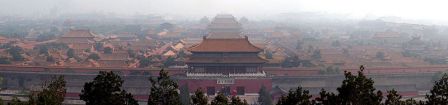
The Forbidden City was the palace of the Chinese emperors during the Ming and Qing dynasties. It is located in the heart of Beijing, the capital city of China, and is the largest ancient palace in the world.(wow an impressive feat huh) 


When was it built? 

The Forbidden City was built under the orders of the powerful Yongle Emperor of the Ming Dynasty between the years 1406 to 1420. More than one million people worked on the construction of the expansive palace. The best materials were brought in from all over China including specially made "golden" bricks, logs of the rare Phoebe zhennan trees, and blocks of marble. When the palace was completed, the Yongle Emperor moved the capital of the empire to Beijing city. ( this is one expensive project, just imagine the amount of money used!)

How big is the Forbidden City? 

The Forbidden City is enormous. It covers an area of 178 acres that include 90 palaces with courtyards, 980 total buildings, and at least 8,700 rooms. The total floor space is over 1,600,000 square feet. Imagine if it was your job to clean that floor. The emperor had an army of servants, however, to take care of his palace and all the people that lived there. ( what a hard time they will have cleaning up the whole palace)

Features 

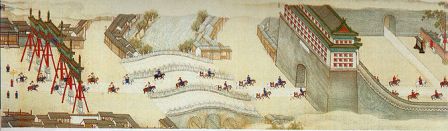
The Forbidden City also served as a fortress to protect the emperor and his family. It is surrounded by a 26 feet high wall and a 170 feet wide moat. Each corner of the palace has a tall guard tower where guards used to keep watch for enemies and assassins. ( it still got penetrated though, thus no fortress is all powerful, not even the forbidden palace)

Each side of the palace has a gate with the main gate being the Meridian Gate to the south. The other gates include the Gate of Devine Might to the north, the East Glorious Gate, and the West Glorious Gate. 

 
An ancient painting of the walls of the Forbidden City

Layout 

The layout of the Forbidden City followed many Ancient Chinese rules of design. The main buildings all were aligned in a straight line from north to south. There are two main sections to the palace: the outer court and the inner court.
  • Outer court - The southern part of the palace is called the outer court. It was here that the emperors conducted official ceremonies. There are three main buildings in the outer court including the Hall of Preserving Harmony, the Hall of Central Harmony, and the Hall of Supreme Harmony. The largest of the three is the Hall of Supreme Harmony. It was in this building that the emperors held court during the Ming dynasty.
  • Inner Court - To the north is the inner court, where the emperor and his family lived. The emperor himself slept in a building called the Palace of Heavenly Purity. The Empress lived in a building called the Palace of Earthly Tranquility.
 
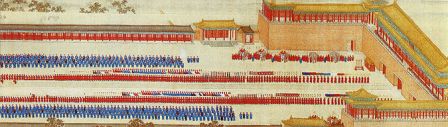
People lined up in the courtyard of the palace

Special Symbolism 

The Forbidden City was designed using Ancient Chinese symbolism and philosophy. Here are a few examples:
  • The buildings all faced south which stood for holiness. They also faced away from the north which symbolized the enemies of the Chinese, cold winds, and evil.
  • The roofs of the buildings in the city were made with yellow tiles. Yellow was the exclusive color of the emperor and symbolized his ultimate power.
  • The ceremonial buildings are arranged in groups of three. The number three represented heaven.
  • The numbers nine and five are used often because they represent the majesty of the emperor.
  • The traditional five elemental colors are used throughout the design of the palace. These include white, black, red, yellow, and green.
  • The roof of the library was black to symbolize water in order to protect the writings from fire.
  • The crown prince lived in a building built using green bricks, green represents growth and thus symbolized his growth.
Is it still there today? 

Yes, the Forbidden City still lies at the center of Beijing city. Today it is the Palace Museum and houses thousands of artifacts and pieces of art from Ancient China. Though quite a lot of the ancient artifact were destroyed or plundered during the war, majority is still housed in the palace. It has withstood time itself and endured eroding. This made the Forbidden City one of the largest and most ancient monument ever built in mankind history.

Interesting Facts about the Forbidden City
  • Twenty-four different Chinese emperors lived in the palace over the course of nearly 500 years.
  • About 100,000 artisans and craftsmen worked on the palace.
  • The last emperor of China, Puyi, continued to live in the Forbidden City for twelve years after he abdicated the throne in 1912. He had a contract with the government to allow his to remain in his inner court but due to rebellions, he was forced to leave the palace.
  • The Chinese name for the palace during ancient times was Zijin Cheng which means "Purple Forbidden City". Today the palace is called "Gugong" which means "Former Palace".
  • It is included in the '7 new wonders of the world' an outstanding feat that acknowledged the work of our ancestors.
  • It is one of the only visible man made structure from outer space.( imagine the size of this huge sleeping dragon. 

Credits to Google.


Douglas
Beijing National Stadium is China‘s official national stadium. It is also known as the Bird‘s Nest for its shape. The stadium was designed to be used for the 2008 Summer Olympics and Paralympics. It is located at the Olympics Green. The construction cost of the stadium is US 428 million. The design was awarded to a submission from the Swiss architecture firm Herzog & de Meuron in April 2003 after a bidding process that included 13 final submissions. The design,  which originated from the study of Chinese ceramic with steel beams implemented to hide supports for the retractable roof, gives the stadium the apperance of a Bird‘s Nest. This showed the continuous development since long ago in the pre-dynastic periods. This is one of the most significant forms of Chinese art. I feel that the Beijing national stadium is a really magnificent and outstanding architecture. It shows how China‘s improvement from a developing country to a much better country. However the arts is not lost but instead used in architecture even in modern days. The stadium is a great example.


China---Part 1


Great Wall of China 

Sin Re 
   The history of the Great Wall of China linked back to when fortifications built by various states during the Spring and Autumn and Warring States periods were connected by the first emperor of China, Qin Shi Huang, to protect his newly founded Qin Dynasty against invasions and attacks by nomads from Inner Asia.
   I feel that the Great Wall of China is a very meaningful symbol of the perseverance of the people of China. It is because to build such a magnificent object, much perseverance and good planning is needed. Because of this fact, I have a newfound respect for the Great Wall of China and the people of China. For the Great Wall to be built, teamwork is also much needed and much communications must be made. People have also sacrificed themselves to build the wall which was the first line of defense of the country. The wall is also an ingenious idea as it is indeed effective in protecting China during wars. 
   Even though we learn many negative points about the people in China, the Great Wall of China provides us with a platform to view the people in a different light and realise that the people in the past are not so different from us and everyone still has negative and positive points that make up their failures and successes, both that are recorded and kept to allow future generations to gain knowledge and learn from. In this way of thinking, all people of the past play a great part in how sucessful we are able to be as the same mistakes will always be repeated, only in different situations, if the lessons are not learnt. Therefore, we should always learn history with the mindset of learning from the experiences of other people and not be so quick to judge them and if they can be our learning figures and we can pick up values to improve ourselves.


Regina
The Great Wall of China was built by the first emperor of China, Qin Shi Huang, to protect his newly founded Qin Dynasty against incursions by nomads from Inner Asia. Later dynasties differed in their approach to Qin's precedent. The Han, the Northern Qi , the Sui , and particularly the Ming were among those that rebuilt, re-manned, and expanded the Walls, although they rarely followed Qin's original routes. Conversely, the Tang, the Song, the Yuan, and the Qing mostly left the Walls to rot, having resolved the Inner Asian threat through military campaigns and diplomacy (the Tang, Yuan, and Qing), or were simply{\] took weak to build walls (the Song). I think that the Great Wall of China was a magnificent project, both literally and figuratively. The Great Wall of China was a project to protect China and nevertheless, it's length is about 21,196 km. From the main purpose to build this wall in the first place, I can thus conclude that Qin Shi Huang was very protective of China. However, the few dynasties which have chosen to left the wall to 'rot', can also imply that it is because they think they are the strongest and thus confident that even without the wall, the dynasty can successfully function, thus, no need for the rebuilding of the wall. This will also enable us to link it to the Sino-Centric Worldview. In my opinion, this project was something very significant to China as it stands as one of the seven wonders in the world. After learning more about the Great Wall of China, I can understand more clearly of the initial intentions of building the wall and it also allows me to be able to link it back to their current worldview.